Reverse Hyper
Correct and strengthen your lower back

The reverse hyper (aka reverse hyperextension) is an exercise that targets your posterior chain, specifically your glutes, hamstrings and lower back muscles (spinal erectors). The exercise and the development of the machine are often credited to Louie Simmons of Westside Barbell. While it's unclear if Louie was actually the first to envision the exercise, he was certainly the man responsible for popularizing the exercise for both rehabbing and strengthening the back.
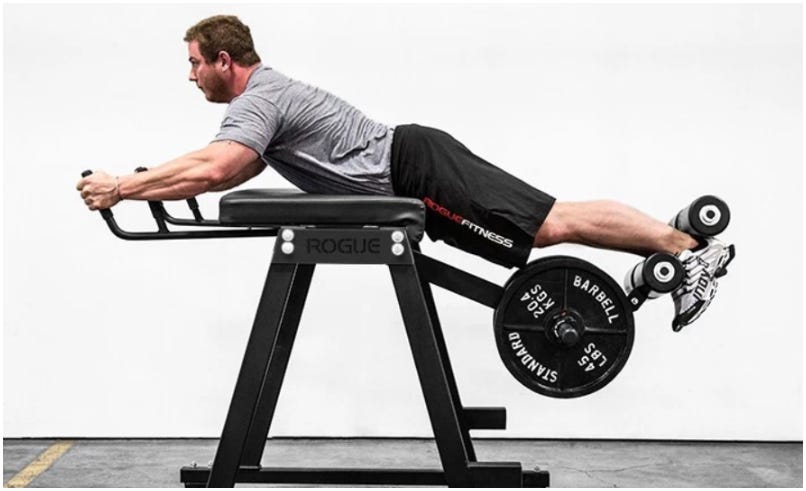
In the mid 70's, Louie fractured his lumbar vertebrae while doing good mornings. Unable to train, he came up with the idea of doing the reverse of a hyperextension. By lying on a workbench, he found he was able to exercise his back without pain. Utilizing the reverse hyper, he was able to both rehab and strengthen his back and return to top form as a powerlifter.
As Louie discovered, the reverse hyper machine is an excellent exercise for both back rehab and prehab. Use of the machine will activate spinal traction, which is a form of spinal decompression. It relieves pressure on the spine and can be effective for sciatica, herniated discs and pinched nerves. The authors have personally utilized the reverse hyper to rehab our backs from deadlifting injuries and to strengthen the lower back to support broken lumbar vertebrae.
The spinal traction occurs as you lower your legs towards the floor. As this movement occurs, the spine is opened up and the compression on the discs is released. On the upwards swing of the legs is where the strength development for the posterior chain occurs. It is important to activate the glutes and hamstrings at the top of the exercise to optimize the effect of the exercise, rather than simply allowing the legs to fall back down.
The reverse hyper is superior to other non-loading exercises designed for back rehabilitation (bird-dog crunches, cat camel, etc). This is because the afore mentioned exercises do not strengthen the back. You must create progressive overload to strengthen the tissue, which these exercises do not allow for. The reverse hyper does. To increase the strength of the large muscles, you must challenge them adequately and increase the training load gradually.
Beginners should start out by simply performing the exercise unweighted and work up to four sets of 25 repetitions without weight. From there it is reasonable to begin adding weight. Reverse hypers can be programed into your week 3-4 times without any issue and can be utilized after the main portion of your session has been completed. For anyone with lower back issues, it would be wise to utilize the reverse hyper year-round. As noted above, the authors have utilized this exercise with great success.